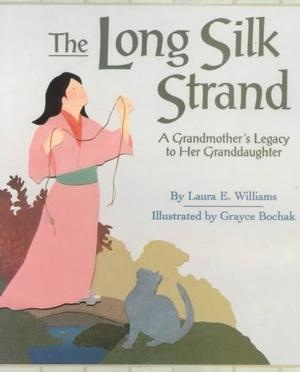
 | Williams, L. (1995). The long silk strand: A grandmother's legacy to her daughter. Honesdale, Pennsylvania: Boyd Mills Press. The tale of a grandmother her takes out a bag of silk strands and rolls them together to make a big ball. As she adds a piece to the ball, she tells her granddaughter how she came to get that piece of silk. All of these stories are stories of her life. While the granddaughter enjoys the stories, she is distraught when her grandmother dies in her sleep after she has finished making the ball. The young girl begins to look for the ball only to not be able to locate it. She finds a strand hanging down but when she tugs on it, it will not come down. She climbs the silk strand until she reaches her grandmother high above the clouds. She promises to stay with her grandmother, who happily accepts, but she tells her that they must say goodbye to her family. She realizes that she will miss them, but she did make a promise to her grandmother. Her grandmother understands and tells her that she will always be with her and breaks of a strand for her to take. As she returns to earth, the strands begin to disappear. The girl now understands that this is the first strand in her ball that she will one day share with her grandchildren. Reminiscent of stories that my grandmother shared with me as she made her quilts. The story shows the passing of stories from one generation to the next. The illustrations are very well done. The illustrator, Grayce Bochak uses paper cutouts on backgrounds to create the illustrations. |
Shea, P. (2003). The carpet boy's gift. Gardiner, Maine: Tilbury House Publishers. Nadeem has been sold into slavery by his parents for a peshgi. He works for Master in a rug factory in Pakistan and has for the last three days. He works from sun up to sun down seven days a week in hopes of repaying the 1,000 rupees loan. However, the closer he gets to repaying the debt, the ore fines he accrues. One day, during a rare day time delivery, he notices a red and yellow flag. As he and his friend Amina walk home that night they inspect it and he finds out that it is a school. He wonders aloud if they would every get to attend. Amina admonishes and tells him it is best to not consider the future when they have only the factory to look forward to. The next day, a boy parades by with the same flag and Nadeem goes to see what he has to say. Iqbal informs them that as the result of a new law, all of them are free and no longer have to work for the master. Frightened about leaving, the children refuse to leave, but Nadeem doesn't forget the encounter not the yellow pen that Iqbal leaves with him. Nadeem hurries home and discusses the situation with his parents. However, they are afraid that their youngest son will also be forced to work in the factory if they encourage him. The next day, Nadeem convinces the other children to confront the Master. He laughs at them and imprisons Nadeem and fines him 500 rupees insuring that he may never leave the factory. Shackled to his loom he is discouraged until Amina delivers the shocking news that Iqbal has been killed. With this news, Nadeem uses his yellow pen and loom knife to free himself and the children of the factory as they walk out of the factory. Iqbal was a real Pakistani boy, who also worked in the factories of Pakistan. Discontent, he began to attend rallies held by the Bonded Labour Liberation Front. This organization was helping children just like him. He spent his youth educating child laborers of their rights. He was honored by an international labor conference in Stockholm in 1994 and received the Reebok Youth in Action Award. Unfortunately, Iqbal was killed outside his home at the age of 12. A very moving story. The story line is one that raises concerns about the issues of child labor around the world that continues to be in existence despite laws against it. | 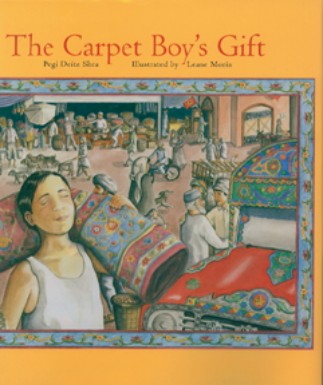 |
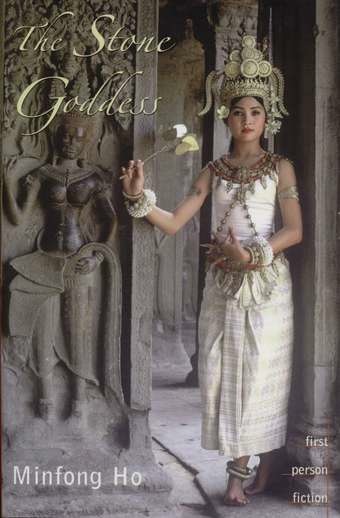 | Ho, M. (2003). The stone goddess. New York: Orchard Books. The story of Nakri, a young Cambodian girl, whose family is torn apart with the arrival of the Khmer Rouge, centered around an underlying theme of the dance of the apsara, a Cambodian ritual dance that requires a lot of training . Nakri and her family begin the story living in Phnom Penh, where her father is a teacher. When the Khmer Rouge march through, forcing everyone out of the city and into the surrounding countryside. Nakri, her sister, Teeda, and brothers Yann and Boran journey with their parents to their grandparents. Along the way, they walk with other families displaced by the Khmer Rouge. Arriving in her grandmother's village, they realize that things will never be the same. Fearing all those who were educated, the Khmer Rouge took Nakri's father away and he was never seen again. Meanwhile, Nakri, Teeda, and Boran were forced with thousands of other children to work in the rice fields. Malnourished and plagued by illnesses, many of these children died. After four years, the camps are plagued with malaria and Teeda dies, devastating Nakri. With her death, the end of an era comes with the arrival of the Vietnamese army. Returning to their grandmother's village, they find themselves in a peculiar place as to what to do next. The family decides to journey to Thailand where refugee camps have been set up. Once in Thailand, the family makes a connection with an American who helps them go to the United States. The transition to the United States is a difficult one, with the climate change, the food, and the language. Boran decides it is too difficult to master the language and fit in at school. He decides to drop out. Nakri makes the transition, but not without a lot of effort on her part. Finally letting Teeda go, Nakri realizes that there is a way to remember her sister and her homeland, through the dance of the apsara. The Stone Goddess was a beautiful story. I enjoyed learning about Nakri's journey through her eyes. The strength that she displays as throughout her trials and tribulations makes you admire her even more. The story, which is written by a Thai who was in the refugee camps when the Cambodians poured across the borders, places the reader right there with the action of the story. |
Souci, R. (2002). The silver charm: A folktale from Japan. New York: Double Day. A wonderful tale of a young boy who lives in a traditional Ainu fishing village on an island called Hokkaido. Accompanied by a small puppy and a fox cub, Satsu was given free reign of the village, with two rules: do not go into the forest surrounding the village because an ogre lives there and do not loose a silver charm that has been passed down from father to son for many generations because misfortune will fall on him. One day, Satsu lost track of where he was and found himself hungry and on the edges of the forest, without his ever present friends, the puppy and fox cub. Suddenly an ogre appears and threatens to eat him for eating his berries. In exchange for his life, Satsu gives him his silver charm. Upon leaving the forest, Satsu becomes weak and falls to the ground. With the help of his pets, his parents return him home where he becomes even sicker. The village shaman warns that without the silver charm, Satsu is sure to die. Not wanting their friend to die, the fox cub and puppy go in search of the ogre who Satsu's silver charm. Along the journey, they become hungry and chase a mouse. Fearing for his life, the mouse pleads for his life. Once it is granted, the mouse offers his assistance, which comes in the form of changing the pair into a boy and girl who entertain the ogre while the mouse retrieves the silver charm. Successfully getting the silver charm and running from the forest, the pet return the silver charm to their owner who immediately begins to feel better. As a reward, the mouse and his family now live with the family. A tale that exposed me to a whole new culture. It made me go and research the Ainu. The illustrations reveal the distinct culture of the Ainu and the tale exposes the religious and cultural beliefs of the Ainu, who are animists, believers in all things nature. | 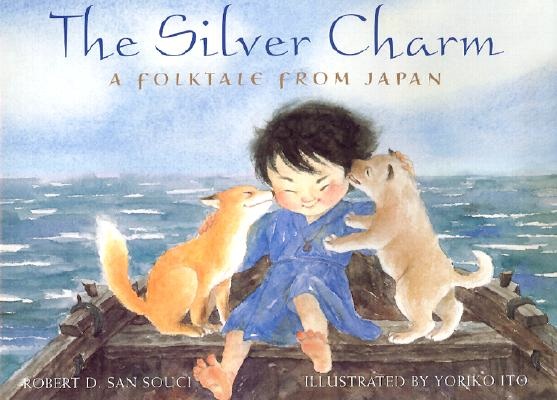 |
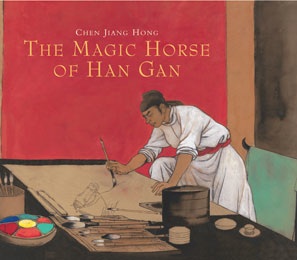 | Hong, C. (2006). The magic horse of Han Gan. New York: Enchanted Lion Books. Han Gan, a poor boy, loves to paint. Although his family is too poor to afford supplies, Han Gan is discovered by Wang Wei, a famous painter, while delivering food. Painting his favorite subjects, horses, Han Gan is invited by the Emperor to enter the academy as an official painter. One day, Han Gan is approached by a warrior seeking a powerful horse that he hopes Han Gan can bring to life with his wonderful painting skills. Disappointed with the resulting painting, Han Gan throws it into the fire. Suddenly, a horse springs from the fire, surprising both the warrior and Han Gan. The warrior charges into battle with his horse, where he becomes invincible. After a period of time, the horse becomes saddened and runs away. It is later discovered that the horse returned to one of Han Gan's paintings. Han Gan, a real life painter, lived more than 1200 years ago in China, leaving the magic horse as a legend. The author/illustrator painted the illustrations in a style similar to Han Gan's. The resulting illustrations are beautiful, seeming very realistic.
|
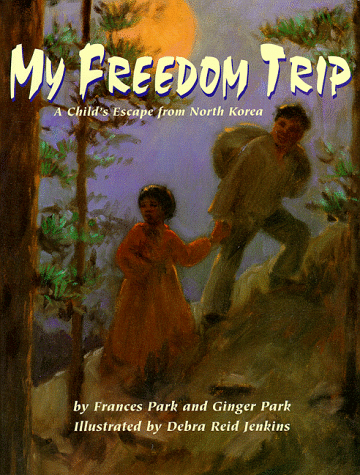 | Park, F., & Park, G. (1998). My freedom trip: A child's escape from North Korea. Honesdale, Pennsylvania: Boyds Mill Company. Written by the daughters of a little girl whose family wanted to escape North Korea and the restrictive lifestyle that became a way of life when Korea was split into two countries. Soo's friends are slowly disappearing from their village as their families steal away in the middle of the night. Her father tells her that he must follow Mr. Han across a river into South Korea. The only catch is that he must go alone and he will send for Soo and her mother later. Not wanting him to go, Soo and her mother wonder each day where he is and when will word come for them to follow. Finally, Mr. Han comes for Soo and her mother urges her on, making her promise to be brave. Journeying first by train and then by walking through the mountains, Soo and Mr. Han come to the river where they are met by a soldier that orders them back to their village. Mr. Han pleads for him to let Soo cross the river to where her father is waiting. Finally relenting, Soo is allowed to cross the river to her father. However, with the ensuing Korean War, the border is closed and Soo and her father never see her mother again. This story has similar parallels to those of the Underground Railroad, with Mr. Han playing the role of Harriet Tubman. Soo and her family's desire to be free of the strict rules that have descended upon their people can be used in the classroom to compare and contrast the lives of slaves living in the American South prior to the Civil War. 1999-2000 Georgia Book Award Picture Story Book Nominee |
Garland, S. (1993). The lotus seed. San Diego: Harcourt Brace Jovanovich, Publishers. When the emperor of Vietnam abdicates his throne, Ba witnesses him crying. As a means of remembering him, she steals into the Imperial garden and takes a lotus seed, which she wraps in the silk of her ao dai. As time goes by, she keeps the lotus seed in a special place and keeps it with her for luck on her wedding day. As war arrives in Vietnam, Ba is forced to leave by boat with her children and the lotus seed. When she arrives in America, she reconnects with other family members who all live in one house. One day, the narrator's little brother asks questions about the lotus seed and finally decides to take the seed and plant it in a pool of mud. Ba is distraught that she has lost the emperor's lotus seed. The following spring, the a pink lotus sprouts, much to Ba's delight. When the blossom fades and turns into a pod, Ba gives each of her grandchildren a seed to remember her by. Garland allows the reader to see into the life of a Vietnamese refugee who is forced to adapt to a new way of life in a country where everything is different. They are able to accomplish this while maintaining continuity within the family and their culture. | 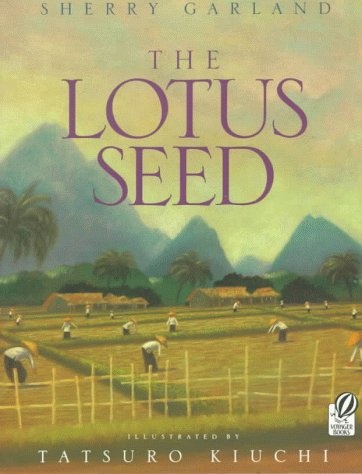 |
 | MacMillan, D. (1994). Tet Vietnamese new year. Berkeley Heights: Enslow Publishers, Inc. One of the volumes of the Best Holiday Books, Tet Vietnamese New Year details the Vietnamese American traditions in celebrating the New Year. The book outlines how families get ready for Tet, a three day event, and ways that children celebrate in school. It also discuss the night Tet begins, the day of Tet and the celebrations that occur during this time period. A very informative text for one unfamiliar with the Vietnamese holiday. I was a little disappointed by the use of children of other cultures in some of the photographs. The book included many Vietnamese words and their pronunciation, as well as background information on the Vietnamese and the historical beginnings of the holiday. |
Brown, T. (1995). Konnichiwa! I am a Japanese-American girl. New York: Henry Holt and Company. We are introduced to Lauren Seiko Kamiya, who is a Japanese-American girl living in Northern California. The story takes us through her preparations for the annual Cherry Blossom Festival, where she and the female members will be performing traditional Japanese dances. She allows her into the daily activities of her life: going to Clarendon School, a public school where Japanese and English are taught to those interested, alternating between her grandmothers after school, and her preparations for the festival. A kid friendly book that allows others to experience the life of a Japanese girl living in America. We are introduced to some of the language and we have the opportunity to see how much are lives are similar and different at the same time. | 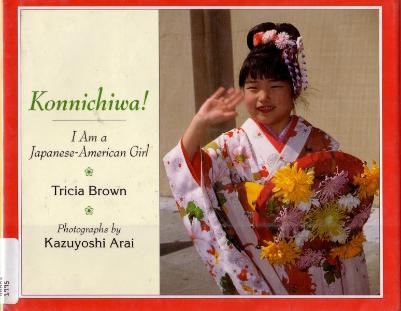 |
