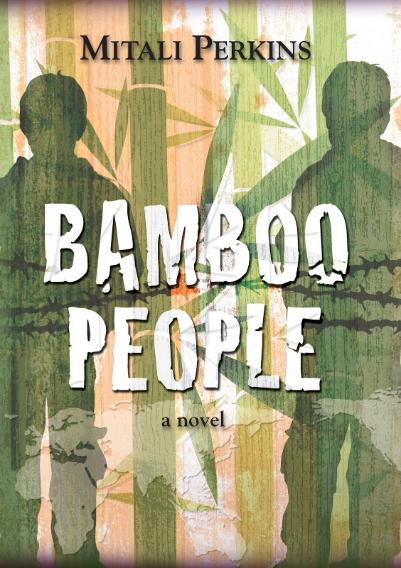
Perkins, M. (2010). The bamboo people. Watertown, Ma: Charlesbridge. The Bamboo People was broken into two sections: Chiko and Tu Reh. Chiko is a Burmese boy who has watched his father imprisoned because of his knowledge. Promising to take care of his mother, Chiko is torn between going out and earning money or hiding behind the walls of their house to ensure that he is not forced into serving in the army. He is able to convince his mother to allow him to apply for a teaching position, which turns out to be a trick in order to round up additional boys to add to the army. Here, he finds out just how much of the world he did not know about despite having read many books. In the training camp, he befriends a street boy, who he initially thinks is ignorant. Their friendship saves his life and they work together to ensure their survival. Tu Reh is part of the Karenni people, an ethnic minority that is being oppressed in Burma. They are fighting the Burmese to retain their independence, while the Burmese is attempting to eliminate them. Angered by the actions of the Burmese and the burning of his village, Tu Reh is forced into making a difficult decision, when he and his father come across four Burmese soldiers that were blown up by a land mine. On a collision course of fate, the two forge a friendship that defies the climate that they are living in. The awarding of the Skipping Stone Honor Award in 2011 meets the criteria for the multicultural and international book category in that the book shows how two boys from different ethnic groups within the same country were able to build of bridge of communication and understanding. They were able to appreciate the other’s differences and were able to walk away richer from the experience. While others wanted Tu Reh to kill Chiko because he was Burmese, Tu Reh was able to see Chiko as a boy another human being forced to bring war to their doorstep.
|  |
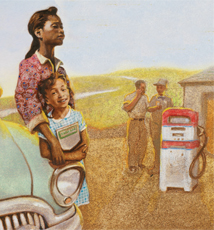 | Ramsey, C. (2010). Ruth and the green book. Minneapolis: Carolrhoda Books. Ruth and her family embark on a road trip from Chicago to Alabama to visit her grandmother in the family's new car. Along the way, Ruth realizes that the world is very cruel. Making stops becomes difficult, as Ruth and her family cannot be shared because of Jim Crow laws. A stop at her father's friend's house in Tennessee offers some relief when he suggests that they stop at Esso Stations, the only gas stations that will serve African Americans. Here they not only receive service, but they purchase a copy of The Green Book. The Green Book provides them with the names and locations of hotels, gas stations and other establishments that will serve African Americans. Finally, they are able to continue on their journey to Alabama with the help of friends. I like this story from the perspective of a child. Ruth is similar to most of my students who are unaware of the "real world" outside of their neighborhoods. Ruth understands that their are rules on what she can and cannot do, but the reality of it is nothing like she would have imagined. In spite of the treatment that she and her family receive, Ruth doesn't turn bitter or disenchanted. Instead, she goes on to help others find their way in the world during the Jim Crow era. I likened this to my students because I think a lot of the time, they think that it could never happen to them or they would have fought the system had they lived during these times. Here is a perfect example of how to take a bad situation and find some good in it. Despite all my readings about African American history, this was my first time hearing about The Green Book. It was actually a publication that was created by Victor Green and was used by African American business men and families that were traveling. It provided them with safe havens while they traveled. I also learned that Esso Gas Stations were among the only gas stations that sold to African Americans and sold the Green Book for seventy-five cents. The book continued to be sold until July 2, 1964 when President Lyndon Johnson signed the Civil Rights Bill into law, making it illegal to discriminate against customers. 2011 Skipping Stone Honor Award |
Fine, E., & Josephson, J. (2007). Armando and the blue tarp school. New York: Lee & Low Books, Inc.
Armando is destined to be los pepenadores, a trash picker. He is needed to help his family earn money. However, the arrival of Senor David and his blue tarp school change the course of his life forever. Despite his mother and father's initial hesitation, they come to the realization that education is a way for Armando to find a better way of life. Happily, he attends school with the other children of the colonia. One night, the family is awakened by a fire that tears through the colonia. Everything is lost, but the blue tarp school. The community pulls together to rebuild and their efforts are reported by the newspaper, which uses one of Armando's illustration of the fire on the front page. Senor David and his blue tarp school receive an anonymous donation to help them build a permanent school, where the students can continue to learn. One of the interesting things fromthis book is that Senor David understands the importance of an education for these children of the trash heaps. He explains to them that school is anywhere learning is going on. It is even more exciting to see children who want to learn, not have to learn. Unfortunately, the students that I serve don't have that thirst for knowledge that it seems students in other places have. Instead, we deal with discipline problems, lack of motivation, that seems to expand a lot of the energy. This story is actually based on true events. Senor David is actually David Lynch. During his summer vacations, he served the colonia of Tijuana, education the children. Finally, he found that he loved what he was doing and began it full time. His efforts have allowed children to venture beyond their colonia and into San Diego and even New York. Many have gone on to do big things, even become a teacher at the school where it all began. Paterson Prize for Books for Young People Children's Books of the Year, Bank Street College Children's Book Committee Skipping Stones Award, Skipping Stone Magazine Lasting Connections, Title Book Links "Choices", Cooperative Children's Book Center (CCBC) Editor's Favorites, The Bloomsbury Review San Diego Book Awards, Picture Book Winner |  |
