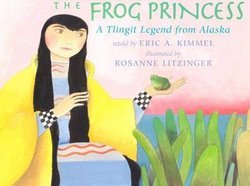
 | Kimmel, E. (2006). The frog princess: A Tlingit legend from Alaska. New York: Holiday House Being the most beautiful girl in the village and the village headman's daughter, she is faced with suitors who want to marry her, all of whom she finds unacceptable. One day, she states that she would rather marry a frog from their lake. That night she is visited by a handsome young man who is from the Frog people. They marry and have children and she is very happy. Only her family does not know where she has gone and think that she has died. One day, upon hearing a traveler's tale, he learns that she is living with the Frog people. He asks the frog chief to send back his daughter or risk war. The frog sends her back, only she has changed and is not happy. She is unable to talk and pines for her husband and children. She finally disappears again and the frogs are never heard from again, until a traveler is asked by a frog to tell the headman that his daughter is well and happy. The School Library Journal finds that the illustrations portrayed in the story are inaccurate in that the blankets do not have long fringes and are not decorated with abstract designs and animal patterns that represent the eagle or raven family. Additionally, the headman's beard should be similar to that of a Vikings and his skin color should vary. |
Kimmel, M. (2000). Montezuma and the fall of the Aztecs. New York: Holiday House. Montezuma was the ruler of the vast Aztec empire in 1502, which took up much of present day central and southern Mexico. He built his empire by conquering all of the people around the Aztecs, demanding that they give gold, jewels and their people who were in turn sacrificed. This created tension in the area that would later lead to the downfall of the Aztec empire. As the Spanish explorer, Hernan Cortes arrived in the waters near the empire, Montezuma sent scouts to welcome them to the empire. With their great weapons, horses and dogs, these Spanish strangers frightened the scouts away. Montezuma instead welcomed them into the village. Distrusting the Aztec, Cortes takes Montezuma hostage and takes over the capital city of Tenochtitlan. In an attempt to keep others from trying to take over their new found treasure, Cortes took some of his men to defeat them only to find that the Aztecs had grown tired of their presence. Although it is unclear which events actually lead to Montezuma's death, we do know that he died during this time and the Spanish were forced to leave the capital. Over the next few months, with the assistance of other natives who were angry with the Aztecs, the Spanish won. The Aztecs had become weakened as a result of a hunger, thirst and a devasting case of small pox. The Aztec nation had fallen, giving birth to the new nation of Mexico. The enormity of the presence of Europeans in the Americas is clearly evident in the story of the Aztecs and the native people that were living in present day Mexico. Approximately 25 million natives lived in this area in 1520. In less than one hundred years, this area would see its population reduced to barely one million people. This lead to an entire civilization disappearing forever. Kirkus Review found the portrayal of this event by Kimmel lacking in authenticity. Instead of a more accurate telling of this unsettling time in history, we are presented with a bland glossed over accounting. The review also points out that the illustrations do not provide the reader with an inaccurate picture of what was happening in Tenochititlan. They further point out that the architecture and dress are generic and the action in the story take place offstage. Publisher's Weekly finds that if this book was used to introduce children to Montezuma, then they would be left thinking that Cortes was a liberator not a conqueror, as this correction is only made in the author's notes at the end of the book. | 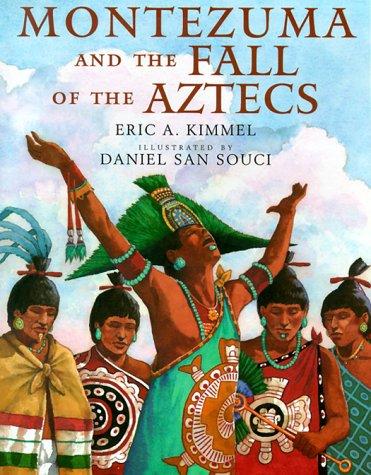 |
 | Duncan, L. (1996). The magic of spider woman. New York: Scholastic Inc. A stirring tale of a wayward Navajo girl who follows her own path. After spending the summer in the mountains with her sheep, Wandering Girl returns to find her people hunkered down for the winter. Cold and shivering, she pleads to the Spirits to help her. Spider Woman has offered to show her how to weave blankets from the wool of her sheep, but only if she keeps a promise. However, with no home she still faced with a problem. When Boy With a Dream approaches and offers marriage, she readily accepts. After a winter of creating drab blankets, she looks forward to creating vibrant blankets from the colors of spring. Excited by a new creation that pops into her head, the girl, who is now known as Weaver Woman begins to weave day and night, until she falls ill. Her husband seeks the help of the Shaman. Because she disobeyed the Spider Woman, her soul was captured in the blanket she was working so hard on. After begging forgiveness, Spider Woman creates a pathway to freedom, which she teaches the others and ensures that they understand not to disobey Spider Woman request to not allow their pride to become their master. The illustrations of this wonderful legend that has been passed down from generation to generation were created by Navajo artist Shonto Begay. |
 | Shahan, S. (2012). Ice island. New York: Delacorte Press. Tatum, a kass'aq, a Yupik word for white man, lands on Santa Ysabel Island with her mother for what should be a week long house sitting job. Tatum dreams of running the 1,049 mile Iditarod one day. So, when Cole, a Yupik youth, asks her if she would like to train with him, she jumps at the chance. However, a blinding snowstorm sends them off track, and she must work together with Cole and the dogs to survive. In reading multicultural literature, there seems to be a recurring theme of trying to encourage the young people to hold on to the culture. In Ice Island, Cole's grandfather believes that TV has casued the young people to question the old ways and look for other ways to survive. Many have left, leaving the elders to keep the traditions going. I am not sure how this particular book appeared on my radar. I know that it came up during a search. I was under the impression that Cole's character would play a larger role and thus this may not be a good example of Native American literature. |
