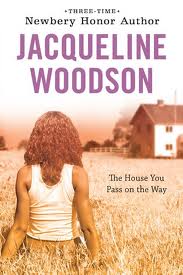
 | Woodson, J. (1997). The house you pass on the way. New York: Puffin Books. Growing up in a most African American community in South Carolina, Staggerlee, whose real name is Ida Mae battles with the isolation that she feels from being the product of an interracial marriage. As a loner, she often finds herself on the outside looking in and longs to make friends. Only the kids in the community avoid her because her mother is white. The community thinks that her mother is a snob because she rarely interacts with those in the community. When the new girl moves to town, Staggerlee finally has a friend, Hazel. Hazel and Staggerlee's relationship continues to grow, including them kissing. Somewhat embarrassed by the experience, Staggerlee hides their friendship, which falls apart when Hazel finds out about her mother. Meanwhile, Staggerlee's family finally hears from her father's estranged sisters, who have not talked to him since he married. His sister writes to inform him that their sister Hallique has passed and that they should mend fences. She offers to send her adopted daughter for the summer, so that they can get to know each other. Staggerlee is excited about meeting her new cousin, Trout. She finally has someone to confide in and tell all of her secrets to, including the fact that she kissed another girl. She also finds out that Trout is having trouble with her own sexuality. Staggerlee's journey toward becoming a teenager is similar to that that is experienced by many preteens. They struggle to understand their bodies as well as the dynamics of friendships. I have many friends whose extended families have young girls that are struggling with the issue of being biracial. Many of them can't seem to find a way to identify themselves. As Staggerlee states when she is asked if she is black or white, "I am just me." We have to help our young people to make this confusing journey from childhood to adulthood.
|
Polacco, P. (200). In our mother's house. New York: Philomel Books. A very cute story told by an African American girl who is adopted by Marmee and Meema. Three years later, they add Will and three more came Millie. The narrator talks about everything she loves about Marmee and Meema, they house they grew up in, and their neighborhood. Despite the happiness that Marmee and Meema, Mrs. Lockner's prejudice against the lifestyle that they lead attempts to rain on everyone's parade. But, Marmee and Meema take special care to deflect her hatefulness and cocoon them in love and happiness. We follow the family from the kids' arrival in Marmee and Meema's to the death of Marmee and Meema and the memory of the closeness that they shared. An excellent choice for partners to share with their children. It helps to show how normal a life they can experience and that no one else's thoughts and views should shape how they conduct their lives. It also goes to show how a household with two moms is no different than one that has a mom and a dad or just one mom or dad. | 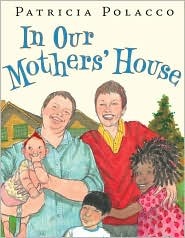 |
 | Stryer, A. (2007). Kami and the yaks. Palo Alto, California: Bay Otter Press. Kami and his family make their living at the base of the Himalayas, providing supplies and transportation for the climbers that come to defeat Mount Everest. Their yaks are missing and his father and brothers are off searching for them. Kami wants to help, even though he is deaf. Using his whistle, given to him by one of the climbers, Kami sets out to find them. Only they are not responding to the whistle as they normally do and a storm is fast approaching. He finally finds them, but they refuse to move. The youngest yak has gotten stuck in a rock and can not free itself. Unable to help free him, Kami runs back to his family and finally gets them to understand that the yaks need help. Kami has saved the day and the family's yaks. I can't imagine how it must feel to have a disability and no one around you can understand how to communicate with you. Kami has existed in a world of silence and can only rely on gestures to make himself understood. This book could be used to help students understand that even kids that have disabilities can make a contribution. |
Abeel, S. (2003). My thirteenth winter. New York: Orchard Books.
My Thirteenth Winter is a memoir written by Samantha Abeel, a young lady with a learning disability, dyscalculia. She is unable to tell time or comprehend any of the concepts associated with time, count change, or calculate tips. She has trouble with spelling and grammar and anything that requires her to follow a process. Samantha talks openly about her struggles with her disability and how it impacted and continues to plague her on a daily basis. Reading My Thirteenth Winter reminds me of our daily struggle in ensuring that we provide students with the best education, while meeting their individual needs. It also draws attention to the deficiencies that exist in placement and testing of students who have needs that can not be addressed in the regular education classroom. Witnessing Samantha and her parents struggle to achieve this was painful. To be told in second grade that your child has a learning disability and is gifted, so we are going to put her in regular education class had to be difficult. But these are the experts so who are they to argue. It took almost five more years of watching their daughter flounder before they stepped up and become the advocate that she needed. I would love to read this with my class, an EIP class. I think that it would serve to show them that there is hope for them if they continue to work hard and make sense of their world. |  |
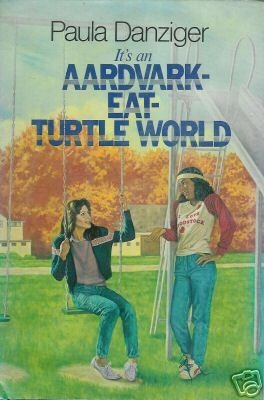 | Danzinger, P. (1985). It's an aardvark-eat-turtle world. New York: Delacorte Press. Rosie, whose mother is white and Jewish and whose father is black and Protestant, has met her best friend on the Divorce Express. The Divorce Express is a bus that runs between Woodstock and New York. The two become "sisters" when Rosie's mother and Phoebe's father become involved and decide live together, making them the family that Rosie has always been searching for. While Rosie seems to accept the changes that have been made, Phoebe is having trouble adjusting and then the trouble begins. Phoebe has been caught making out with her boyfriend and she decides she no longer wants to be part of the family and moves back to New York with her mother and stepfather, who really doesn't care for her. Not to mention, she feels like she has also lost her best friend, Rosie, who found a new boyfriend during their trip to Canada, where Rosie was supposed to be acting as a buffer between Phoebe and her mother, not making new friends. I think that this is your typical story of what children go through when they are affected by divorce. It would be an excellent selection to show students that there are other kids that are thinking and feeling the same way that they are feeling. Rosie comes across as a well adjusted teenager, who sometimes doesn't understand her role in the world. She sometime battles with her race, but not enough to distract her journey to adulthood. |
Forrester, S. (199). Dust from old bones. New York: Morrow Junior Books. Dust From Old Bones finds us experiencing three months in the life of thirteen year old Simone Racine during 1838 in New Orleans through her journals. Simone is a member of the gens de couleur libre, or free people of color, having mixed African and European ancestry. Unable to pass for white, Simone is forced to watch favor be heaped upon Claire Marie, her cousin, who can pass for white. Simone must instead be groomed for the life of marriage to a tradesman, instead of one how will become the mistress of a rich Creole planter. Simone, however, finds favor with Tante Madelon, who is visiting from Paris, after she has heard that her father is dying. Tante Madelon, or Aunt Madelon, fills Simone's head with dreams of leaving New Orleans for Paris. Simone is excited by the prospect and secretly makes plans to leave when Madelon returns. Tragedy befalls Claire Marie's world when her father can no longer support them and they are forced to give up the private school, fancy clothes, and furnishings. It also means that they must sell their slaves, which have been with them for years. Distraught, Simone searches for a solution, which ultimately means that she must help them escape to Canada with the help of Tante Madelon. Only Madelon and Claire Maire have other plans. They plan to run off in secret to Paris together without Simone. So the death of her mean grandfather, loss of her newly found aunt, and best friend and cousin Claire Marie, leaves Simone in a tailspin that ends with her helping Paulette and Eulalie, the household slaves escape. A very good look at the lives of the gens de couleur libre during the early 1800s. As the Afterword suggests, quoting Alice Dunbar-Nelson, little is known about this culture and maybe one day it will better known. The book does put me in the mind of Cane River, written by Lalita Tademy. I also liked the fact that the book showcased the problems that existed in families where shades of color prepared you for one course of action versus another. In the case of Simone and her mother, who were too brown to pass, they were expected to find a trademan to support them, while the lighter girls were prepared for a life of luxury and protection from the wealthy planters in the surrounding areas, who used New Orleans to conduct business and to get away from the plantation. I also find it interesting that there was little hope for those who wanted to find another course for their life. Simone and her brother, Gabriel had their lives planned before they were even born. To be born in an era where I had some choices! |  |
