Bishop, C., & Wiese, K. (1938). The five Chinese brothers. New York: Coward-McCann Publishers. Set in a sea side village, five brothers, each who has a special talent, live with their mother. One day, Brother One allowed a little boy to accompany him while he went fishing. Brother One was able to swallow up the sea and told the boy to come when he gave the signal. So excited, the little boy paid no heed when he was given the signal. Unable to hold the sea back any longer, the little boy was swallowed up by the sea. Brother One was found guilty and sentenced to death. Begging an opportunity to see his mother, he is able to leave and switches with the next brother, whose special power will help them overcome the punishment set forth by the judge. This continues until the village finds that since he can't be killed, he must be innocent. As I looked for reviews for The Five Chinese Brothers, I looked at both Amazon.com and Epinion.com. Most of the reviews on amazon.com come were favorable and really liked the book. Their reviews looked beyond the illustrations illustrations and concentrated on the story. Epinion.com reviewer, Mary Ellen, has reviewed more than 1300 books. Her of The Five Chinese Brothers was objective and she provided the good, the bad, and the ugly. She points out that all of the characters in the story were painted yellow to depict the Chinese characters. She found that while some might find this offensive, she did not pointing out that all of the illustration in the book are displayed in a similar manner, using only yellow, black or white. She also thought that people might find the depiction of all of the characters offensive in that they looked alike. In order for the illustrations to match the story, the brothers had to look alike. Most importantly, Mary Ellen really did consider pulling the story because of the references to capital punishment, emphasizing that this is an unusual topic to be found in children's literature. However, in reading it with her children, she found that it is a good opportunity for discussion on the topic of justice and she and her husband did not suffer as children from hearing the tale and neither will others. I tend to agree with her assessment of the book. | 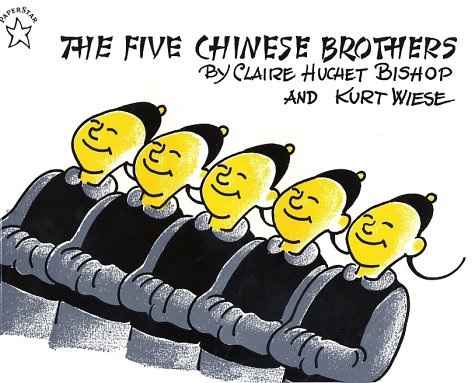 |
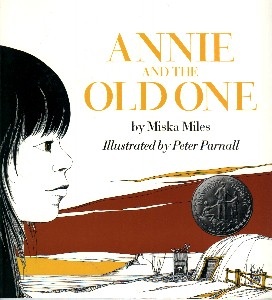 | Miles, Miska. (1971). Annie and the old one. Boston: Little, Brown and Company. A touching story of a granddaughter who cherishes the time she has shared with her grandmother and does not want to say good bye. In this story set in a Navajo hogan, Annie is told by her grandmother that it is time that she learns how to weave. One day she announces to the family that when the new rug is completed, she will go to Mother Earth, but before she goes, each of them must select a gift. Annie chooses her grandmother's weaving stick. Each day, Annie's mother works on the new rug, much to the dismay of Annie, who understands that her grandmother will die once the rug is complete. Annie comes up with different ways of preventing her mother from finishing the rug, in an attempt to delay the inevitable. Her grandmother confronts her and tells her that she is trying to hold back time, but this can not be done. After their talk, Annie understands what she must do and decides that it is time for her to learn how to weave. In the New York University's Literature, Arts, and Medicine Database, I founded a literature annotation for Annie and the Old One. The author, Sandra Bertman, of this annotation found that the illustrations in the book were not good depictions of Navajo culture and tribal life. She further points out that Navajo grandmothers would not sit with their legs crossed nor would Navajo children deal with death by acting out. 1971 Newbery Honor Book 1971 Christopher Award Winner ALA Notable Children's Book |
Bannerman, Helen. The story of little black Sambo. Brooklyn: Handprint Books, 2003. The story of a little boy whose mother presents him with a newly made red coat, blue trousers, green umbrella and purple shoes with crimson shoes. As he walked through the jungle, a tiger happens upon him. In exchange for not eating him, little black Sambo offers the tiger an article of clothing. As he continues his walk, he encounters other tigers how finally leave him with none of his fine clothes. Then he hears a great noise and comes upon the tigers fighting over who is the grandest tiger. As they continue to argue, catching each other by the tailing and running around a tree, little black Sambo asks them if they want his clothes any longer. Instead of letting go of each other's tail, the tigers could not respond and thus, little black Sambo skipped away with his clothes. The tigers continued to race around the tree until they melted away becoming a large pool of melted butter at the foot of the tree. Coming upon the melted butter, little black Sambo's father takes some home to his wife who makes a feast of pancakes for her family. Oh, how I looked for this book in a more dated edition. I was so sad upon finding that the main library was unable to find what their catalog stated was the only approved American edition. But I will continue to look for a copy. An illustrator's note accompanies this edition of the book. The illustrator, Christopher Bing, states that the book has never been out of print since its publication. He reveals that it was never Bannerman's intention for the book and accompanying illustrations to be published. However, at the instance of her friends, the book was published. The book also contains some thoughts and a bit of history. Originally published in 1889, the story of little black Sambo began as a letter to Bannerman's two daughters, while she was traveling through India. The original illustrations depicted a fuzzy haired native with thick lips and bulging eyes, all sterotypes of the locals. The appearance of this book in America struck at the racist stereotypes of African American images during the 19th century,The use of the name Sambo also made the text offensive. While the prefix Sam- is a very popular Indian boy's name, Sambo was a term used in the Caribbean to those of mixed race that were three quarters black. Later it would come to mean a lazy black male. I was able to see a copy of the illustrations and text at http://www.sterlingtimes.co.uk/sambo.htm. Interesting to say the least. Not really sure I was offended by the illustrations for this particular edition. Until I saw the comparison between Sambo and Squibba. | 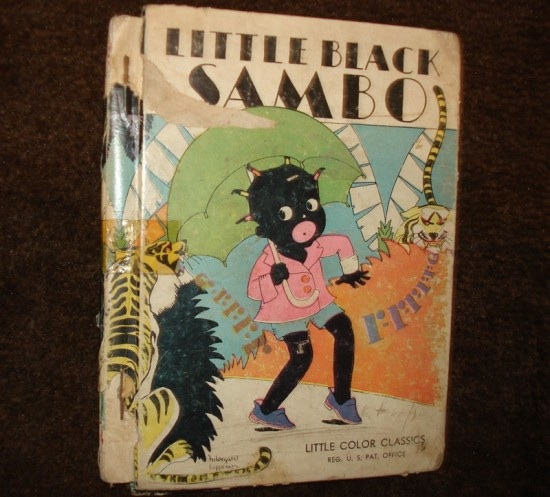 This is not the edition that I had access to, but I did find this image under racist books and thought it would appropriate to include under the Informed Choices tab. 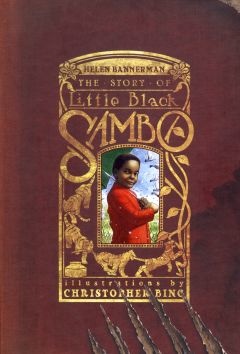 |
